Yeshwantpur – Howrah:My wife Prachi, my sister Hema and I started our journey to east of India on December 24th evening, for which the planning and preparations began a month ago. Though Yeshwantpur Howrah express was scheduled at 7.30 PM, we reached Yeshwantpur station an hour earlier due to
trafficophobia that we developed after coming to Bangalore. We waited in the first class waiting room which was packed with passengers and their piled up luggage. The special odour (from the toilet) unique to the Indian Railways was preparing its passengers for their journey ahead.
We boarded the train as soon as it came, at 7.00 PM. It was entirely packed. The unreserved compartments were overflowing with passengers due to vacation. Most of them were labours from Orissa and West Bengal, traveling to their native. Our co-passengers were a very old couple who needed assistance even to get up, accompanied by their not very helpful son in his middle ages. The old man looked very confident, kind and had good command in English. As soon as the train started its journey, we started playing dumb charades on Hema’s request. It was a good fun with Prachi’s lack of knowledge in Tamil films and Hema’s lack of knowledge in Hindi films. After an hour, we un-wrapped the
aloo paratha and had our dinner. I was quite amazed with the eating habit of the old couple. They had
poori sabzi, which is the most staple food of
Bengal. Immediately after dinner, each of them had a big share of sweet. This happened after each meal. This was quite surprising for me after seeing a lot of old people who restrict themselves from taking sweets either due to diabetes or fear of diabetes. Even they did not restrict themselves from having non vegetarian food served in train. Only after reaching Kolkata I came to know that chicken, fish and egg constitute a major part of the diet. Everyone went to sleep around 9.30 P.M, with the son of the old couple and I reading book till 10.30 P.M.
Next morning started very early at 6.30 AM, in terms of rail passengers. All of us were engrossed with some book or newspaper. The entire day was spent with book, playing cards, chess or some activity like charades, getting down at major railway stations and having timely food which we had got packed from home. Our food consisted of
thepla and
poori. A glimpse of Bengali intelligence was displayed in the train itself. Another co-passenger of ours’, a lady nearing her 50’s, very silent all the time was knitting some woolen clothing till she slept in the night. The next morning I saw her solving suduko in the newspaper. Earlier I had not seen such kind of women solving Suduko in South India.
Train was late by an hour when it reached Vishakapatnam. It had a long break here allowing me to walk down the platform to give a look to the unreserved compartment. Surprise, pity and sympathy filled my heart. It was really in-human conditions in which the people were packed and still people from this station were boarding. Majority of the passengers in these compartments were labors who had to travel long distance, who cannot plan their travel in advance, who were poor to afford even the sleeper class ticket. Rest of them were short distance travelers who wanted to travel faster at less price and who did not mind of the discomfort for some hours. I wonder whether there can be any solution to this problem, like increasing the number of unreserved compartments. I also came to know that the Indian Railways with an attitude to serve this chunk of people had begun a new train called “garib rath” in the Bihar route which is ‘supposed’ to have cheaper fares. This train in itself is a different story.
The interesting part of today’s travel was the
rail bridge over River Godavari in the state of Andra Pradesh. This is the lengthiest bridge and the widest river I had ever seen in India. It spans around 2.75 KM wide. As I understand, the bridges are built in the place where width of the river is narrow, compared to other places. So, imagine how wide this river is. It looked massive like a sea or a strait.
I got up at 5.30A.M, next morning, completed my morning duties, waked up my partners. We were ready to get down in another half an hour. The first place that we planned to visit in Bengal was
Santiniketan. We were planning to take santiniketan express which was at 10.10 AM. But the previous night we decided not to waste 3.5 hours at Howrah station, instead to take a bus to santiniketan. As it was getting late than 6.30 AM and by seeing people not getting ready, I came to know that the train was late. Train was at Kharagpur station at 7 AM, where I had the first glance of Bengal in my life. It was a cold morning. Lot of chaiwala selling tea in mud cups for Rs.2.00. We were discussing that the train would atleast reach by 9.00 AM, and we would have 1 hour to catch the next train. Train was entirely late to reach Howrah at 9.45 AM.
Howrah – Bolpur:
We were confused whether to go for Santiniketan express or not, as we had no booking for it, we were new to the place, we didn’t know where to book tickets. But thank god! I had a vague idea of the station premises as I had discussed about the station premises and places to stay, with my Colleague Amitava Mukherjee who hails from Kolkata. We carried our big luggage and ran to the current reservation counter, only to know that the booking for that train is not done there. The officer there was so kind to give us wrong information that the booking is done in second floor. I, leaving the other two ran to the second floor, where I was told that the train was about to leave and the booking can be done in the old station. There are two stations Old and New, one beside the other separated by Yatri Nivas. The long distance expresses trains towards south runs from New Howrah. The local trains and expresses to north run from Old Howrah. There are 2 current reservation counters, one just outside the Old Howrah station and other inside New Howrah station at the entrance. We had to run along the crowded path to reach Old Howrah station to see a queue in the unreserved ticket booking counter. Our dilemma still grew seeing the crowd. I gave a try running to the current reservation counter just outside the station. There was also an enough lengthy queue. I came back, stood in the unreserved counter to book. It was all a gamble to catch the train. The moment I got the ticket, our sprint started towards platform number 9, which is the usual place for Santiniketan express. Thank God! We finally did catch the train. My partners, being ladies, were comfortably seated in the unreserved ladies compartment. Though I was standing, I was comfortable than my fellow Indians who travelled in the unreserved compartment from Bangalore to Howrah. I was standing till Bardhaman, a small station where many people alighted.
As I had to skip breakfast, I had some groundnut and tea sold by vendors. The land was totally dry on both sides of the track. There were no agricultural lands or any vegetation. Very little greenery could be seen all through the path. Herds of cattle found completing the remaining green for their half stomach meal. But I saw a lot of small water bodies at regular intervals. I think either the land should be very poor in nutrition or people should be lazy or poor to do agriculture or might be due to harsh winter. As I was contemplating on all this, the train stopped at a very small station with no amenities and did not leave for a long time. I got down to know that the rail track ahead was blocked by supporters of
Mamta Banerjee who was on 22nd day of fasting protesting against the forceful acquisition of farm lands at Singur by West Bengal government for
Tata’s small car project. The train which was supposed to reach Bolpur, which is the nearest railhead for Santiniketan, at 12.30 noon, reached at 2.00 PM. Our plans were a flop due to this delay. We planned to visit the Rabindra Bhavan, a museum on
Rabindranath Tagore on the day we reach there. We planned two days in Santiniketan. We reached on Tuesday. Wednesday was official holiday at Santiniketan. So, we had to miss our visit to RabindraBhavan.
Other attraction all through this journey (also during our stay in the east) was the
Bhel-Puri kind of stuff that was sold by many many vendors and eaten by huge population. We came to know that this is
Jal-Muri. From my basic Bengali knowledge that I got from my Bengali room partner, Pranay,
Muri means
Pori or Murmure or mamra. The vendors have specially designed equipment, in which they carry all the raw materials that are required, a container to mix, a cash box and a dirty towel. This entire equipment is made portable, which is hung around the vendor’s neck. This goes at a very cheap rate of Rs.5 per cup. The cup is also specially made in paper. I think this is a very well run small scale industry of West Bengal, helping a lot of families in their daily living.
Bolpur Station:
As soon as the train reached Bolpur station, thousands of people thrown themselves into the train in a desperate move to get seat, without allowing the passengers to get down. There were few brawls which were not very rare scenes for Indian travelers. Prachi and Hema got down with great struggle as they carried our entire luggage. As there was
Poush mela, one of the very important events of this place which hosted people from all over the world, going on, there were few foreign travellers with children too. They were all shocked by the crowd they saw.
Bolpur – Santiniketan:
As we came out of the station, there were hundreds of
rickshaw-walas thronged upon us to get hired. Normally as per Indians standards, the rickshaws or the taxis inside airport or railway station cheat and charge heavily thinking that the person would be a novice to the place. It’s always better to hire a taxi or rickshaw outside the premises. So, following the Indian norms we came out of the station rejecting a lot of offers. It was really a crowded place. We didn’t get any rickshaw outside the station. I was very irritated with the train journey that we had with lot of struggles and delay. This was growing my frustration, standing in the crowd and waiting for rickshaws. In the mean while Prachi took the initiative and enquired a police constable about reaching Hotel Camelia, where we had booked room for our stay. We felt so lucky when he showed us a pick up van from the hotel coming towards us. We boarded the so called van and reached the hotel along with another old couple. We had to convince ourselves that the van was comparatively good than other vehicles we saw.
Hotel Camelia:
Hotel Camelia is very far from the
ViswaBharathi university campus, with reference to the scale of the village. But it is only less than 4 KM from the Village centre. We freshened ourselves with the little hot water that was provided in 2 separate buckets. Hot water is only available during morning. We went to have lunch that had been ordered from the room earlier. We had a very good lunch. Restaurant became the major attraction for us, even though there were no special vegetarian cuisines. The food was delicious. The breakfast was complementary. Even though, the hotel was little costly and far from village centre, it had good facilities which were unusable at that time like swimming pool and Pool table.
Public transport:
We left the hotel around 4.30 PM and went to the Poush Mela that was going on. The cycle-rickshaws are the popular mode of public transport, which were quite costly. They charge almost Rs.10 per KM and allow only 2 people in one rickshaw. So, we had to hire 2 rickshaws always when we had to go somewhere.
Poush Mela:Poush mela is the year end celebration which is a famous event in the calendar of Santiniketan. Viswa Bharati’s contribution is for the first three days. Later it is run only with the stalls, without any programmes. We went during the tail end. Even then it was a different experience for people like us, who don’t have the opportunity to see this kind of melas in the villages. It was organized in the huge area called mela ground in the university campus.

It was 5.00 PM when we reached the mela ground. But it looked as if it was already 7.00. It becomes dark very early in the evening, in this part of India. This had always been a wonder for me. Yet I have not got a satisfying answer that could explain why different parts of the world have different day time. It was a very traditional mela. The emphasis was on art. There were a lot of display of hand crafts, sand stone work, paintings, clay work and wood work. There was also a large portion devoted to jute. Most of the displays were creative. I think the university had improved the creativity of the entire region. Even tough we had a wish to buy most of them, we restricted ourselves thinking about the scale of our house, where they may turn out to be a burden after few months and will be filled with dust, which can no more turn on the ambience.

No mela is considered complete without fun and food. This was no exception. A huge area was allocated for fun which had many kinds of rides. Please don’t go back to your young day and imagine the ride that you sat on or wanted to sit. I was surprised to see all modern rides which consume huge current. This was the brightest area of the mela too. Food stalls were all through the mela, not segregated into a separate section. We had
pani poori called
 Gol-Gappe
 in this part of India. Though we wanted to have
varieties, we had no space to stack up in the stomach. There were a lot of sweets and special cuisines that could be found in this part of India.
Santiniketan:
Next morning we had a relishing breakfast with toast, boiled eggs, corn flakes and milk. We set out to explore rest of Santiniketan. After lot of confusion on the way, we decided to catch the Santiniketan express at 1.10 PM. Prachi and Hema returned back to Hotel to pack and check out, while I went to the reservation counter at the university campus to book tickets for return journey. We were afraid of the crowd which we found yesterday, fighting to get a seat in un-reserved compartment. I was beaten by the surprise that all the offices including the reservation counter are officially not working on Wednesdays. We had no other option other than travel by unreserved compartment. While waiting for my companions, I went to a book stall near the railway reservation counter to get a tourist guide which would help us explore the place. I got an English book explaining all the places and a Bengali book with a map.
After my companions arrived, we started walking down with help of map. We felt it would be tough to cover the entire campus before noon. My partners suggested taking a rickshaw, which I was not happy with. While discussing these, Hema spotted an auto-rickshaw which was a rare mode of transport in that village. We signed a deal with him that he would take us to all tourist locations in the campus, drop us at each place and wait for us to take us to other place. This worked out very cheap compared to cycle rickshaw. We had to pay him Rs.125. The rickshaw driver turned out very good that he became a guide and explained about each place, took us to hostels and labs. We went around Kala Bhavan, Sangeet Bhavan, Painting school, Chattim Tala, the classrooms without rooms (these were the only thing I knew before I visited this place), Upsana Griha, Tin Pahar and more. I m not explaining each as there are enough information available in the internet. We had a chance to talk to a student from Kerala learning art here. He claims this is the best school for art in India. It is supposed to be. The place and people are filled with creativity beyond imagination. Hema, being in class eleven was getting confused whether to study art which she is very good at or to study science which she has developed interest from discussing with my father, me and my friend Shankar. I understood that she was calming herself saying that science would be her profession and art would be her hobby.
We were unfortunate to miss many places like museum and library due to Wednesday holiday. At the end of the trip we set another deal with the auto rickshaw driver to take us to the Hotel, wait for sometime and drop us down at the Bolpur station for and additional Rs.75, which was another profitable deal. After settling the bill, we started immediately for Bolpur. Our misfortune still continued. The auto got punctured on the way. The auto driver got the help of few people near by and immediately replaced the tyre. One good fortune in between the misfortune was that there was a spare wheel (called stepney in India). We paid his bill and hurried to ticket booking counter to find a long queue. While Prachi stood in the queue, I called up Hotel Sana in Kolkata, where we had our booking to confirm our arrival. Booking the ticket, we ran towards the unreserved compartment. My partners boarded the ladies compartment. This time they were not lucky to get a seat. I stood near the door and toilet all through the travel of two and half hours. We reached Kolkata around 3.45 PM.
Arrival at Kolkata:
As soon as we came out of the station, we had a chance to see the Kolkata that we had heard of

always. Hundreds of men and women marching from the ferry ghat to the station with red flags, depicting that it is a communist state. We were little tensed as we were new to the place and worried about our stay. Refraining from getting cheated by taxi drivers, I stood in the pre-paid taxi queue. Hotel Sana, which was supposed to be in the S.N. Banerjee road, was on a small, nasty road which bifurcates from S.N. Banerjee road. It did not seem to be a hotel. It was an old building. Mentioning it to be an old building would not be a unique identification, because 80% of the building in this city was old. As we entered the hotel, it seemed to be a residential building. Few children were playing cricket in the left over space in the parking area. The hotel was in the 2nd floor. The reception in less than 100 Sq.ft had a very nominal look. It did not give me a good impression. The room was very small like an air-conditioned godown. None of us liked the room and the Hotel entirely. It was not at all suitable for families. There was a theatre in front of the hotel, which screens adult movies.
Vegetarianism in Kolkata:
Everyone was hungry and Hema was tired out of hunger. We had seen a big restaurant on the way to the hotel. We decided to go there and continue with the rest of the activities. Unfortunately, the restaurant turned out to be non-vegetarian. There was a road-side
dosawala, where my partners didn’t want to eat. We landed up in a small but good looking restaurant, only to find that it only looks good. We realized that finding vegetarian restaurant in Kolkata is a tough task.
Desperate search for better hotel:After filling the stomach, we decided not to continue our stay in this hotel. We walked a few minutes to find another hotel on the same road, looking quite good. But as we entered and saw the rooms, we understood that this is a similar hotel. This is when the preparation and planning that were made before the trip helped us. Prachi had made note of all the hotels that she came across while searching on the internet. We called up
Hotel Broadway, which we were to book before booking Hotel Sana. They said they don’t have and immediate vacancy. But a room is getting vacated in the night. We decided to visit the hotel once before we land up there with all luggage. We struggled to reach the place as we were not aware of the public transport system. Taxis and Rickshaws were not ready to take us there. With the help of a shop keeper, we came to know that the distance to that place is very less and taxis won’t take us there. Hence we had to walk down in a congested street looking like a
bazaar of smuggled goods, to reach the hotel. While walking down, I got a lot of offers to buy blue films. Hotel Broadway didn’t allow us to look into a room, but confirmed that we will get the room by 9 o’clock. We left the place immediately. My partners were not ready to walk back through that road again. While we were struggling to get a taxi, Prachi came out with an idea of hiring a taxi for a round trip. We made a deal with a Taxi driver for round trip. We went back to Hotel Sana, informed that we are checking out, packed our things and settled the bill of Rs.770 just for 3 hours and dropped down at Hotel Boadway in the same taxi. The hotel management was so kind to provide us a single room with common toilet, till the double room gets vacated. We waited here till 9 PM. We went down to have dinner and found that the restaurant was more a bar than restaurant. So, we returned back to our room and completed our dinner in the room. We were given a double room around 10 PM.
The room was really really big, old fashioned, with old black coloured wooden funitures and old flush mechanism in toilet, with good service. This is comparable to Hotel Dasaprakash in South India in all terms. All this good service and this big room comes at a nominal tariff of Rs.650. Finally, I felt some relief of staying in a decent place. This half a day in Kolkata was a very bad and terrifying experience.
Dawn of Day1 in Kolkata:
The next morning we got up early as per our plans. Deciding to have breakfast outside, we set out to visit places around 8.30 AM. As the first task we decided to visit the West Bengal Tourism office at B.B.D Bag which was at a walk-able distance from Hotel Broadway. We had a

tough fight in reaching the place as we did not know the exact door number and address. On the way we realized that 8.30 AM is considered to be early morning here. Some were brushing, some waking up, some preparing rotis and kilos of potato either for their self or for selling, washing the taxis and some sitting near the fire. Every activity was on the road. I believed that these activities at this time of the day could be seen in interior or hilly regions of India. But it was shocking to see in a capital city. Kolkata seems to be a lazy city in comparison to Mumbai or Chennai. There were no shops or activity around 8.30 AM. My wife and sister were uncomfortable to walk in the pedestrian platform with all the activities going all along and everyone starring at them. It seems either the women here are orthodox, not going to work or the sex ratio is poor.
West Bengal Tourism:
Finally, when we found the WBTDC office, we were surprised to know the package tours that they operated and especially the rates that were offered. We went in search of Sunderban trip, which was available for minimum of 1 night and 2 days. There were some specific dates on which these are conducted. According to the hand out given to me, December is the month with more trips to Sunderban. As we could not afford our time for the Sunderban trip, we settled to take up a one day sight seeing trip around Kolkata. But we were told that the tickets can be booked only between 10 AM and 4 PM. We had planned to visit Dakshineshwar, Sharda Mutt and Ramakrishan Mutt. We had to make changes to today’s schedule to come back here and book tickets.
Dakshineshwar and Sharda Mutt:After un-succeeding search for some restaurants to have breakfast, we took a
metro from Chandni Chowk metro station which was just opposite to our hotel. The metro rail is as good as the U-Bahn that I was used to in Frankfurt. It looked to be a different world entirely in the underground, segregating itself from that crowded, congested and polluted place lying above. It’s computerized ticketing, automatic ticket checking, the platform, the train, interior of the train, announcement system and everything else we saw was totally amazing. But yes, there is a difference between Kolkata metro and U-Bahn, which I should not forget to mention. That is the crowd. We were just squeezed during commutation.

We got down at Shyaam Bazar to take a taxi to Dakshineshwar. As we were so hungry, we continued our search for restaurant. I was loosing patience in this long search just to eat, when there was lot of road-side vendors, where my partners didn’t want to eat. Finally, I and Hema took a glass of juice, and Prachi gulped a cup of tea in no time. While Prachi proceeded with another cup of tea to the surprise of the vendor, I munched some
samosas. We got some biscuit packets for Hema. One thing to be admitted is that everything is comparatively cheap in Kolkata. A cup of tea (including the mud cup) costs Rs.1.50, one samosa cost Rs.2.
We took a taxi to
Dakshineshwar, as we were advised to do by the Hotel receptionist. But we landed in Dakshineshwar when the meter ticked Rs.150. We didn’t quite expect it. It seemed that we got wrong information from the hotel desk. We had only a 500 Rupee note and a little over 100 rupees in change. I roamed around the nearby hotels, riskshaw-walas and shops atleast for quarter of an hour, to get smaller denomination of Rs.500 to pay the taxi. I came back dejected, only to send my wife who successfully got a litre of drinking water, to make smaller fractions of Rs.500. After paying the charge, we were shocked to see the queue which wound like a snake. As the major reason of our morning trip was Sharda mutt, we decided to proceed without making
darshan.
Prachi guided us to Sharda Mutt, with her small left over memories. We sat in a rickshaw and went through small
galis. I was not allowed to enter the mutt. I sat near the gate where few other male members of some other families were also waiting. After sometime, Prachi and Hema and took me inside to visit the temple alone, from where I could have a glance of River Hooghly which bounds the mutt on one side. Prachi and Hema came out with
prashad after the darshan of
mataji.
At this juncture we were so confused of how to proceed further. We had to return to book tickets for the day trip conducted by West Bengal tourism. At the same time Belur Ramakrishna Mutt was nearer to Sharda Mutt. We skipped Ramakrishna Mutt and returned by the same route at the same expense, but enjoying the real density in Kolkata Metro.
Booking in Vein:
I was not feeling well, as the frequent visitor of mine was with me, “
migraine”. It was so severe due to the hassle we had in the morning, that I just wanted to avoid going out in traffic. I went back to the room alone, while Prachi and Hema went to book tickets for the next day’s Kolkata Darshan trip. After returning they told me that they had hired a hand pulled rickshaw. Even tough I feel pity about this situation of a man pulling another man just to fill his and his dependent’s stomach; I felt I had missed the experience of sitting on the cart over 5ft height. The sad part of this struggling day was that we had no luck to get tickets for Kolkata Darshan. All tickets were booked.
We had a very simple Bengali lunch with
Dal and
Chawal. I had seen my Bengali friend Pranay Nath relishing Chawal only with Dal and green chilli. Prachi being Gujarathi, preferred aloo parata to rice. We had a small discussion of what to do further before I had a deep sleep while my companions had a nap.
Evening walk:To have a break from my migraine, we set out for a walk around the near by places in the
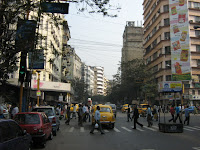
evening. We went to the nearby ATM to withdraw some cash for the next 2 days, before we sat for browsing in the nearby (1Km) internet café to confirm our return train timing. The train timings of the Indian Railways had just got changed. Then we rambled around Ganesh Chandra Avenue, Bentinck Street and Jawaharlal Nehru Road. Sparing me, my companions had the Bengali roadside delicacies golgappe and jal muri. On the way back, our two day search came to an end. We found a decent South Indian vegetarian restaurant, “Hotel Kamal” on Bentinck Street. Prachi was the happiest person to have found this. We had a staple South Indian dinner (yes as always, cheap). We bought two stress balls at cheap rates (Rs.10) during our shopping.
Dawn of Day2 in Kolkata:
Getting up early, we left the hotel, walked down the G.C.Avenue in the pleasant morning weather to book the tickets for next day’s Kolkata Darshan. We were quick to reach the Howrah station after booking, to catch a sub-urban train to Belur Math. We had a bit of confusion in finding the ticket counter. Having traveled in sub-urban trains of Mumbai and Chennai, we had an impression of having separate ticket counters for sub-urban trains and local / express intercity trains. To our surprise, we had to get the sub-urban tickets from the unreserved counter for intercity trains. Even the sub-urban trains and intercity expresses shared few of the platforms in the old Howrah station. We had to wait for more than 30 minutes to still wait more. Sub-urban trains to Belur Math are not frequent. Instead of waiting more and affecting our further plans, we took a pre-paid taxi and reached Sri Ramakrishna Mutt in time, as planned. For the visitors, the taxi drivers outside the Howrah station may turn out very expensive. We were asked Rs.180 for the trip to Belur Math, while we paid Rs.110 for the pre-paid taxi.
Belur Math:
Ramakrishna Mutt is a lovely tourist place more than a mutt, which is visited everyday by more than hundreds of tourist from all over the country. The location, on the banks of River Hooghly beautified the place both scenically and religiously. This being one of the prime mutts in the country did not provide me enough silence and peace to meditate for a few minutes. I enjoyed our time in the museum with Prachi, who had better information on this cult more than what we had.
Mandir and Museum are open till 11.30 A.M. Book shop is open till 12.00 Noon. We had a quick religious dip in the river, which is nothing more than dipping the feet and showering few drops on the head. As soon as I saw the river, there was a flash of the picture of the crystal clear River Ganges at Haridwar, where I and my father had the same religious dip before 4 years. River Ganges, the divinest of the river flowing in this country is polluted so much that it is so turbid like drainage at this place, where it is going to lose its magnificent individuality and mix into the macrocosm of Bay of Bengal.
Belur Math to Howrah Station:
From 12 noon till 6 in the evening, there were no trains from Belur Math station to Howrah station and the station looks deserted except for a few stray dogs and few youngsters. With sheer interest we boarded a city bus to reach Howrah station. The ticket fare was Rs.6.00. More

than the ticket fare, the ticket was interesting. It was a waste paper, meaning it had some prints in it which were not relevant to the ticket. It was of very small size compared to the tickets in other places of India. It clearly gave an indication that it is being reused. I had to turn the ticket few times, either side, to understand the amount printed on the ticket. Should I infer anything about the theory of communism? I m still not clearly answered!!! We had to stand all the way, while the bus fled along the small, dense galis of north Kolkata. I had a chance to have a look at the normal public, closely. There were few young girls around 12 years of age sitting near me, who to my astonishment were gesturing notoriously mature by rubbing
gutkha, chewing and spitting it as and when the bus stopped. All of us were totally hungry, as we skipped our morning breakfast. Hema could not stop herself from opening a packet of biscuit and munching some while standing in the bus itself.
National Library:As soon as we dropped in the bus station which is adjacent to the Howrah station, we rushed to Restaurant Comesum at the entrance of New Howrah station, which we had noticed on the very first day while we were on the way to Santiniketan. It was fully crowded, where my companions had to stand and eat un-willingly, as their legs were paining. But these are un-avoidable in travel.
After a nominal lunch, we took a taxi to the
national library at Alipore. We went through the new bridge paying a toll of Rs.10. For the first time during our stay, we saw some decent areas, while we traversed through the A.N.C Bose Road. The library is located in a very vast campus. The old and the new library building are so elevated to give a majestic look. We had to get permission right from the security as we were not members of the library. After entering, we talked to the chief librarian to get permission to browse through the catalogue. Catalogue itself is a huge collection. Citizens of Kolkata are so gifted to have such a library.
College Street:
We took a taxi to reach College Street cutting across the heavy traffic, not as though in Bangalore where we live. College Street is a hamlet of small cottage book shops, which sell old and few new books. This is one of the most visited and a well known place among the educational but not necessarily intelligent community. The shops were separated according to the subjects of the books sold by them. It would be a waste to roam around without knowing what to buy, as every shop-keeper would literally pull you. Moreover searching without a subject title would be tougher. Most of the books were related to study in colleges and universities. I purchased few books on history, while Hema bought some for her school and Prachi bought the controversial book of Taslima Nasreen. Yeah! Everything was at a very cheap price.
New Market:
Travel with girl companions and without shopping is mere unpleasant. Of course for them! I did not want them to take an unpleasant memory with them. We went to the new market near Esplanade in the evening. This is a shopping area, with a whole lot of shops mostly related to cloth under one roof. We purchased few sarees, dress materials and an artful leather hand bag. On the way back to our hotel, we purchased around 50 rosagullas in three mud pots, from the very famous K. C. Das at Esplanade. We had our dinner at the same South Indian Hotel Kamal. But this time we had Punjabi food which was also decent.
Dawn of Day4 in Kolkata:We vacated the room early in the morning. Every servant in the hotel, from room boy(s) to lift operator were behind us for tip. Even after paying enough of tip, the hotel was affordable when compared to other hotels of its kind. We boarded the bus for Kolkata Darshan, along with our entire luggage, to the surprise of other passengers. It was little bit of discomfort for us to sit with luggage squeezed in the leg space. We started our journey at 9.00 A.M, the so called 8.30 A.M in India.
Belur Math and Dakshineshwar:
Most of the public buildings / places like Raj Bhavan, Eden Gardens, Writer’s building and High Court were shown from the bus. Few of the passengers got restless and inquired whether all places shall be shown from the bus or shall we get time to go around. Our next stop was Belur Math, which we had visited yesterday. From here we were taken to Dakshineshwar via a bridge over river Hooghly, loaded with heavy traffic. We had to waste an hour sitting in the bus due to traffic. There was a huge crowd of devotees at the Kali temple at Dakshineshwar, as it was a Saturday of Poush Mahina. We fortunately got a glance of the goddess.
Jain temple and Kolkata Panorama:

Our next stop was Jain Temple, which was closed as we were little late due to the traffic jam and delay caused by few fellow passengers at Dakshineshwar. We had to enjoy it from outside the main gate. This is one of the best places that we saw during this entire travel. But this does not seem to be a famous tourist attraction. We were taken next to Kolkata Panorama. It is a kind of museum which displays the proud facts of Kolkata and Bengal. It displays the contribution of Bengal to the Indian Freedom Struggle, Indian art and Film industry.
St. Pauls Cathedral and Nethaji Bhavan:
We were given a break of 45 minutes near Esplanade for Lunch. We had a stomach filling but not very delicious lunch at Krishna Vilas in Jawaharlal Nehru Road. Finishing our lunch, we visited St. Pauls Cathedral. It was a good construction from inside. But we were not given enough time as we had few more interesting places to be seen. From here, we went to Nethaji Bhavan, which is the place where where Nethaji Subhash Chandra Bose lived. This is now made into a museum displaying Nethaji’s artifacts. This part of Kolkata, which is the geographical south of the city, seems too posh compared to other parts.
Kalighat:
At last we were taken to the religiously and etymologically famous place, “The Kalighat”, the abode of “Kali – The Fierce Hindu Goddess”. On the way we were shown Victoria Memorial. We could not go inside as it was nearing the closure time. Few passengers got down here itself to get a closer look of Victoria Memorial.
Kalighat was a very nasty and crowded place, where every other
pujari lures to get his pocket filled by doing some
pooja or at least by taking the devotee inside the shrine by-passing the snake wound queue. After suffocating stand in the queue for few minutes, we reached the place from where the deity was supposed to be seen. With so many crowds of pujaris in the
garba-griha like structure, nothing except the color of their attire in the mist of smoke was seen. I was dejected as I was not able to see the depiction of Fierce Kali in Kalighat, which is synonymous to fear. Even my mother and grand-mother told us not to go to Kalighat, especially because Hema might get frightened.
Return to Bangalore:As it was getting late and dark, we informed the guide that we are leaving by our own. As we started walking out of the shrine the power went off, which is not a very infrequent scenario in India. We got very nervous as it was so crowded and we were to find our way to the bus in the dark. But I would attribute this nervousness to the hype of fearsome facts narrated with Kalighat. After some confusion about the roads, we finally reached the bus, where our luggage were stationed. Dragging our luggage, we walked a few distance, from where we got a taxi which took us to Howrah station, quite far way.
We had enough time to relax and get refreshed in the waiting room on the second floor of Howrah station. We had a glimpse of Kolkata at night, taking few snaps of the Howrah bridge. Prachi and Hema had their dinner at Comesum, while I was made the watchdog for the luggage. I had to prefer railway caterer’s food to the Comesum’s delicacies. We had a tamil family settled in Mysore as our co-passengers with 3 kids of different age, which made the journey more interesting. As the next day passed by, Prachi and Hema were feeling un-comfortable health-wise. Prachi skipped her dinner, while I and Hema had the so called Vegetable Biriyani, only to find that Hema got sicker. She started vomiting and we had to end up with our own medication before sleep. Thankfully while Hema was getting worse, we reached Bangalore next morning.
Unfortunately, Hema had to skip her school for the next few days before getting well and travel back to Erode. I happily took the roshgollas for my office colleagues to relish and found that they were rotten. Sunay, my manager and Bhupesh could not restrain themselves from eating a little bit of it and confirming that it is not edible :)
Important Facts:(*) Wednesday Holiday @ Santiniketan
(*) Pick up van for Hotel Cameliais available at Bolpur station
(*) Hotel Camelia is far from Viswa Bharathi Campus
(*) Few cheap hotels in Kolkata has Common toilet facility
(*) Frequent local trains not available to Belur math
(*) Belur and Belur Math are 2 different railway stations
(*) All express trains and south bound trains are from New howrah station
(*) All local trains and north bound trains are from Old Howrah station
(*) New Howrah station and old Howrah station are seperated by Yatri Nivas. They are not connected from inside
(*) Bus Station is adjacent to railway station
(*) Ferry ghat is opposite to station
(*) Pre-paid taxis are available in front of the station
(*) Hotel Camellia, Pranthik, Santiniketan, Bolpur
Tel: 91-03463-54778/ 55044/ 55043 Fax: 91-03463-55044
Meanings of other language words used:
(*) Aloo Paratha - A special kind of roti made with potato stuffing.
(*) Roti - Indian bread made of wheat flour.
(*) Poori - Unleavened, deep fried indian bread.
(*) Sabzi - Side dish mostly made of potato as main ingredient, to be had with roti or poori.
(*) Thepla - A special Gujarati roti made of wheat flour and fenugreek leaves.
(*) Pori / Murmure / Mamra / Muri - Puffed rice, used as snacks in India.
(*) Bhelpuri / Jalmuri - Street snack mostly popular in north India, made of Puffed rice, chopped onion, tomato, small poori, chillis, sweet and savour sauce, corriander leaves. The composition and ingredients vary across the country.
(*) Poush - 9th month of Bengali calender.
(*) Mela - Gathering or Village fair.
(*) Rickshaw-wala - Person pulling or pedalling cycle rickshaw in the context of this text. It can also be a person driving auto-rickshaw.
(*) Pani-puri / Gol-gappe - A very famous street snack made of small puri filled boiled and salted potatos along with savour and sweet water made of tamarind and dates.
(*) Dosawala - Person who makes and sells dosa. Dosa is a south Indian stapple food made of rice batter.
(*) Bazaar - shopping place or a market, usually congested.
(*) Samosa - A cone shaped snack made of boiled and cooked potatoes covered by a layer of maida and fried in oil.
(*) Darshan - Literally means "To see". It is commonly used to refer the vision of God or the deity in temples.
(*) Gali - Very narrow street.
(*) Prashad - Food offered to God as per hindu tradition and consumed by the devotees after the prayer.
(*) Mataji - Literally it means mother. It is used to refer Cheif female saint in hindu religion.
(*) Chawal - Boiled rice. Stapple food of south India.
(*) Dal - Liquid side dish usually taken with Roti or Chawal, made of grams most often Bengal gram.
(*) Madir - Temple or Hindu's Worship place.
(*) Gutkha - Crushed betal nut with small amount of stimulant, which is highly addictive and a known cause of oral cancer.
(*) Pujari - A hindu priest in the temple who does religious rituals.
(*) Pooja - A hindu religous ritual.
(*) Garba-griha - The location in the temple where the statue of the deity is placed.
 the hang-out place for the boys and girls of this area, more than a tourist place. The musical light show has been temporarily suspended due to the renovation work. It did not take more than half an hour to completely walk around this place. In added information on this place - This is place where the first song "Kehna hi kya" in hindi version or "Kannalane" in tamil version of the film "Bombay" was shot. After a little temptation of shopping handloom sarees, we boarded the taxi to reach Meenakshi Amman temple.
  ity check, all tobacco stuff like gutkha were detached from their proud owners and collected at the gate, snatching any chance for these painters to show their modern ‘spit-art’ around the corners. As some more time was left for the temple opening, we went around the temple seeing the fenced music stones (which I had listened a long time back when I visited the temple with my father as a young kid), thousand pillar hall, museum and the black dhoti crowd (Sabarimala devotees). Museum was not lit properly, though it had very good collection of sculptures and paintings. If the thousand pillar hall was vacant it would have been magnificent to look at. Seeing few camels in the prahara, I wondered if the Hindu tradition of Tamilnadu had been modified to allow camel to accompany the lonely elephant. It was well past
  ront of us fainted in the crowd itself. We had been given less than 3 minutes to sit in front of the deity, where a person sung Thirvasagam beautifully invoking my memory of Panayapatti (my native) Shiva
  The route from Tirunelveli to Kanyakumari is through a small town called Valliyur and a small but famous village called Mahendragiri, where ISRO has its
  while my in-laws left to the main-land. I avoided climbing up the stairs to the statue, as I had to remove my shoes. When Prachi was persuading me to remove the shoes, Jayakumar called. He is more accustomed to these places, as his native place is near Nagercoil. I consulted whether we can visit any other place, as we had time. My idea was to visit Mathur Totti palam, which is supposed to be the
  tra spot on the agenda, which irritated me to the maximum. It was actually not an extra spot, rather a substitute for Susindram. Susindram is a beautiful, architecturally rich temple between Kanykumari and Nagercoil. We had to skip this temple as there was a function called Margazhli Darisanam, which had attracted a huge crowd. He is not made for travel. This is my conclusion, every time we travel together.
 ressed places, due to cyclone. This is one of the driest and poorest districts of
  t we were approaching the shores. On a railway crossing we purchased “Panankezhangu” which is tender stem of Palm tree, grown especially for eating. Prachi and her parents were seeing this for the first time, while I took the pleasure of explaining how it is grown and eaten. Ramanathapuram district is one of the highest growers of Palm tree, where every part of this tree is used in some way of the other. The roofs of huts were made of palm leaves; the fence was made of palm stalk or petiole, palm fruit is eaten when it is ripe and before, the tender e
 xtract is used to make alcohol and sugar and more so. With all these narration, we reached
  the mandampam camp, which is the end point of Indian main land. From here Rameshwaram is connected by
  wells. We directly proceeded towards the deity for darshan. After darshan, we had a look at the 1000 pillar corridor, which is the longest temple corridor in world. It was magnificent, though not lit properly. After darshan, we visited Sri Ramakrishna Mutt and spent some time on the so called beach. Later in the evening, Prachi, her mom and I went shopping, leaving her father at Gujarathi samaj, where we planned to have our dinner. My mother in law bought some gifts for her friends and relatives, while Prachi bought some ornaments made of sea shells. On the way back, my father called with a trembling voice and gave the message of my grandfather’s demise. Not waiting for dinner at Gujarathi samaj, we finished our dinner at a hotel. I had to discontinue my trip and proceed for the funeral of my grandfather at a place which was 6 hour journey from Rameshwaram.
 Till some distance the normal vehicles are allowed. Later on sands, only the four wheel drive jeeps are allowed. These jeeps take the tourist to the end of
  devastated and buried in sand, except a few building which remains. There are some fishermen families that live there. Prachi had purchased some sea shells from the kids who were selling them at cheap cost compared to the cost quoted at the shops around the temple at Rameshwaram.


